Tense Graph: A Tool for Visualizing the Logical Structure of Tense
TenseGraph is a web-based service that visualizes the structure of English tenses based on Gilles Fauconnier’s Mental Spaces theory. Rather than viewing tense as a simple timeline, this approach treats it as a process of creating and connecting different "spaces" in our minds. TenseGraph explains this process using the following four core elements:
| Base Space | |
 |
The foundational starting point of the discourse. Usually representing the "present" where the speaker stands, it serves as the root for all temporal shifts. |
| Viewpoint Space | |
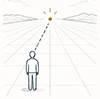 |
The location where the "internal eye" or perspective is positioned. When speaking of the past, our viewpoint moves to a specific point in the past to observe the situation. |
| Event Space | |
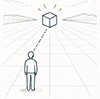 |
The specific point where an actual action or state occurs. The viewpoint and the event may coincide in the same space or exist in separate ones. |
| Focus Space | |
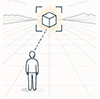 |
The "active workspace" where new information is currently being added. It represents the specific space we are focusing on at the moment of communication. |
In the subjunctive mood, the tense graph does not rely on the usual Viewpoint and Event space. Instead, it highlights two distinct conceptual spaces: Foundation and Expansion space.
| Foundation space | |
| This represents the conditional base or premise. It is not anchored in actual time or events, but rather sets up a hypothetical situation — “if X were true.” | |
| Expansion space | |
| From the Foundation, this space unfolds the possible consequences or developments. It shows what would happen if the condition were realized. | |
Irrealis structure
Thus, the irrealis sentence does not simply place events along a timeline. Instead, it structures meaning through a conditional base (Foundation) and the imagined outcomes (Expansion space), making visible how English uses hypothetical reasoning to extend beyond real-world temporal events. So, we represent the border of the node with a dotted line.
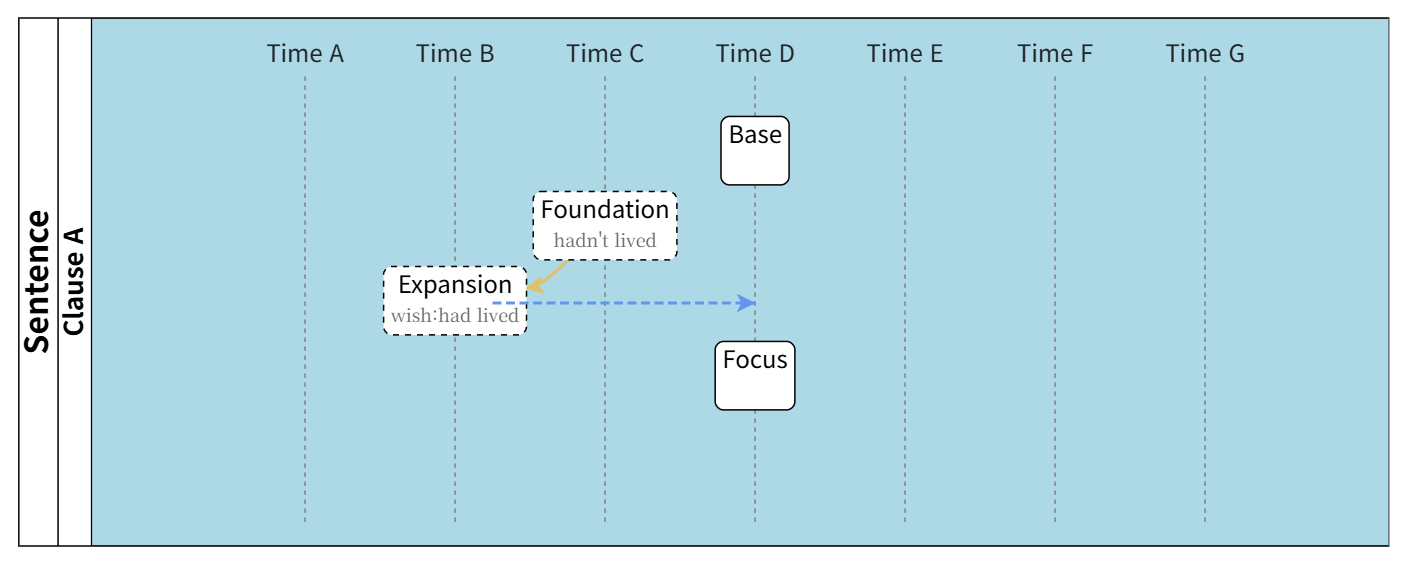
Arrows are used to indicate the flow of time:
 |
wavy arrows represent progression(continuous) |
 |
dashed arrows represent completion(perfect) |
 |
solid arrows indicate intervals and the direction of temporal flow rather than a specific point in time |
By visualizing how these elements are arranged and linked, TenseGraph helps users understand the logical mechanics of language in a clear and structured way.